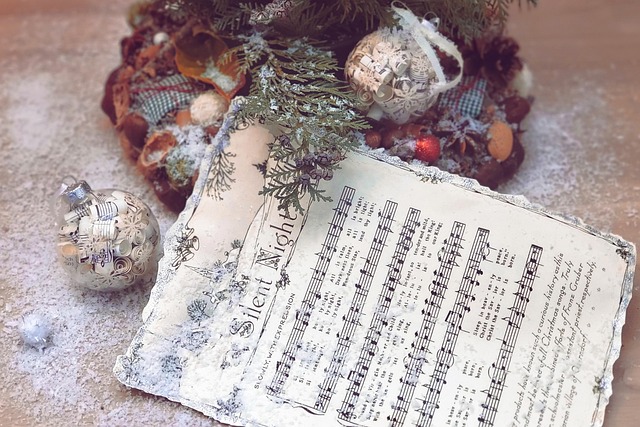
Learn about the creator of Silent Night. Discover who wrote the lyrics and music, how the famous carol was created, and why it became a global classic.
When searching “who created Silent Night,” something interesting emerges: there’s no single creator. This Christmas standard came from two ordinary men in a small Austrian village, working together under less-than-ideal circumstances.
Here’s how it actually happened.
A Priest with a Pen
Joseph Mohr wrote the words in 1816. He was a Catholic priest, but he’d been writing poetry since he was young. This wasn’t some official church commission—he just sat down and wrote it.
The timing matters, as Europe was a mess. The Napoleonic Wars had just ended, and people were hungry, displaced, and broke. Mohr’s poem, which he called Stille Nacht, offered something scarce: a moment of quiet with no angels announcing doom. There is no drama. Just peace, stillness, and a hint that things might be okay.
That’s probably why the lyrics still work.
A Teacher Who Could Arrange
Two years later, Mohr needed music. He brought his poem to Franz Xaver Gruber, the local schoolteacher who also played organ at church.
Gruber wasn’t trying to write a masterpiece. He matched the mood—gentle, uncomplicated, easy to sing with three verses and no vocal gymnastics. The kind of melody anyone could hum after hearing it once.
Which turned out to be the point.
Christmas Eve, 1818
Gruber decided to arrange his melody for guitar so that everyone could sing the song in front of the crib with baby Jesus, a very typical tradition. He and Mohr performed it themselves that night. Priest singing, teacher playing guitar, in front of a small congregation who had no idea they were hearing something that would outlive everyone in the room.
Pretty modest debut for a song now performed millions of times every December. You can listen to the original version here:
How It Escaped Oberndorf
The song could have died there. Instead, it spread through word of mouth—traveling folk singers, repair workers, performers passing through. Someone would hear it, remember it, teach it to someone else.
There was no recording industry, no sheet music initially. Just people who liked it enough to keep singing it. By the mid-1800s, it had jumped borders and languages. Today it exists in over 300 versions, translated into nearly every language imaginable.
Why People Keep Asking About This
The curiosity makes sense. The song doesn’t announce itself, and it’s definitely not showy. There’s no “look what I can do” moment in the composition or the lyrics.
That restraint makes people curious. They want to know: who thought this way? Who decided less was more?
And there’s another thing—plenty of people assume Silent Night is a folk song, something that just emerged from the collective unconscious, but it’s not the case for Silent Night. The documentation is clear: exact authors, precise date, known circumstances.
But it feels anonymous. It feels like it’s always been around.
What Made It Last
Simplicity, mostly. No trained voice required. No orchestra needed. Barely any ability to carry a tune necessary.
That accessibility is deliberate. Gruber and Mohr weren’t writing for the Vienna Philharmonic. They were writing for regular people in a village church for a small congregation.
Turns out, that’s a good way to write something that survives two centuries.
The Takeaway
So for anyone searching for the creator of Silent Night: it’s both of them. A priest who wrote poetry and a teacher who understood melody. One moment of collaboration in 1818.
No grand ambitions, no marketing plan. Just two guys creating a new song on Christmas Eve.
And somehow, that was enough.
German Version:
Keep Learning with MusePrep
Watch our short video lessons on the MusePrep YouTube Channel—ideal for beginners learning ear training and harmony.
Subscribe now to build your ear and master the building blocks of music theory!
Subscribe to MusePrep.
Related Posts:
Borodin In the Steppes of Central Asia: A Musical Journey
Morning Mood by Edvard Grieg – Analysis, History, and Cultural Significance
5 Romantic Era Composer Highlights You Should Know
Debussy Voiles Interpretation: A Complete Analysis of Structure and Style
Composer Highlight: Clara Schumann Biography – Beyond the Notes
Chromaticism in Flight of the Bumblebee: Rimsky-Korsakov
Connecting Music Theory in Repertoire: Make It Stick